Migrate your data without guessing what breaks.
Stryde is a migration platform built for the person who actually runs the project — not a data engineering team. Map, transform, and move data between any two databases, with a risk signal grounded in your own migration history, not a guess.
What doing this by hand actually costs.
Plug in your own table count, hours per table, and rate — this is real math against your project, not an industry average.
Illustrative estimate based on your inputs — not a quote.
Smaller migrations like this often fit inside a single subscription credit — talk to us about the right fit.
Starting price for a single scoped migration — not a quote.
Migrations at this scale are usually multi-system and custom-scoped — talk to us for a real number.
How this is calculated
hours = tables × hours per table
cost = hours × hourly rate
In-house rate: BLS median Database Administrator salary, $104,620/yr (May 2024) ÷ 2,080 hrs/yr ≈ $50/hr base, × a 1.25–1.4x fully-loaded multiplier (benefits + overhead) ≈ $63–70/hr.
Hours-per-table has no universal constant — it's your own estimate. Adjust it for your environment.
Cost with Stryde uses the same estimate above: under $15,000 it usually fits inside a single subscription credit; between $15,000 and $150,000, we show the $15,000–$35,000 per-project range as "starting at $15,000," with savings computed against both ends of that range.
Per-project pricing shown is for a single scoped migration; final price depends on connector mix and environment. Teams running multiple migrations per year typically cost less per-project under an annual plan — ask us.
Want to save money on data migration? Click here to check out the Stryde app →
No catch: self-hosted on infrastructure you already control, zero AI dependency for the core risk engine, and no lock-in on your data or mappings. Prove it against a real migration before you decide anything.
Migration projects fail quietly, then loudly.
A type conversion silently drops precision. A column mapping looks right and isn't. Nobody finds out until the migration has already run against production — or worse, after go-live. The tools built for this are either generic ETL platforms that assume you have a data engineer on staff, or spreadsheets and hand-written scripts that assume you have infinite patience.
No risk visibility before you commit
You map a column, run the job, and find out it failed after the fact — the hours are the cheap part, the rework and re-validation are what blow the schedule.
41% avg. schedule slippage on migration projects †
What finding out late costs
Rework is the expensive part, not the migration itself — manually re-checking and re-mapping every table that failed validation, at whatever your team's time is worth.
A representative 50-table project, by hand: ~$13,000 in labor (4 hrs/table × $65/hr) — before the schedule slip is even counted.
Nothing to hand a stakeholder
"It worked" isn't evidence. There's no artifact to prove it.
Built for the migration project, not the always-on pipeline.
| Generic ETL tools | Stryde | |
|---|---|---|
| Built for | Data engineers, always-on pipelines | Migration owners, project-scoped moves |
| Risk visibility | Find out after the job runs | Flagged live, grounded in your own history |
| Gets smarter over time | Every migration scored in isolation | Learns from every job you've ever run |
| Stakeholder-ready proof | A pass/fail status | A certification benchmarked to your baseline |
| Deployment | Often cloud-only, AI features vendor-locked | Self-hosted, risk scoring works with zero AI |
The “gets smarter” and “risk visibility” rows above, rendered — not just claimed.
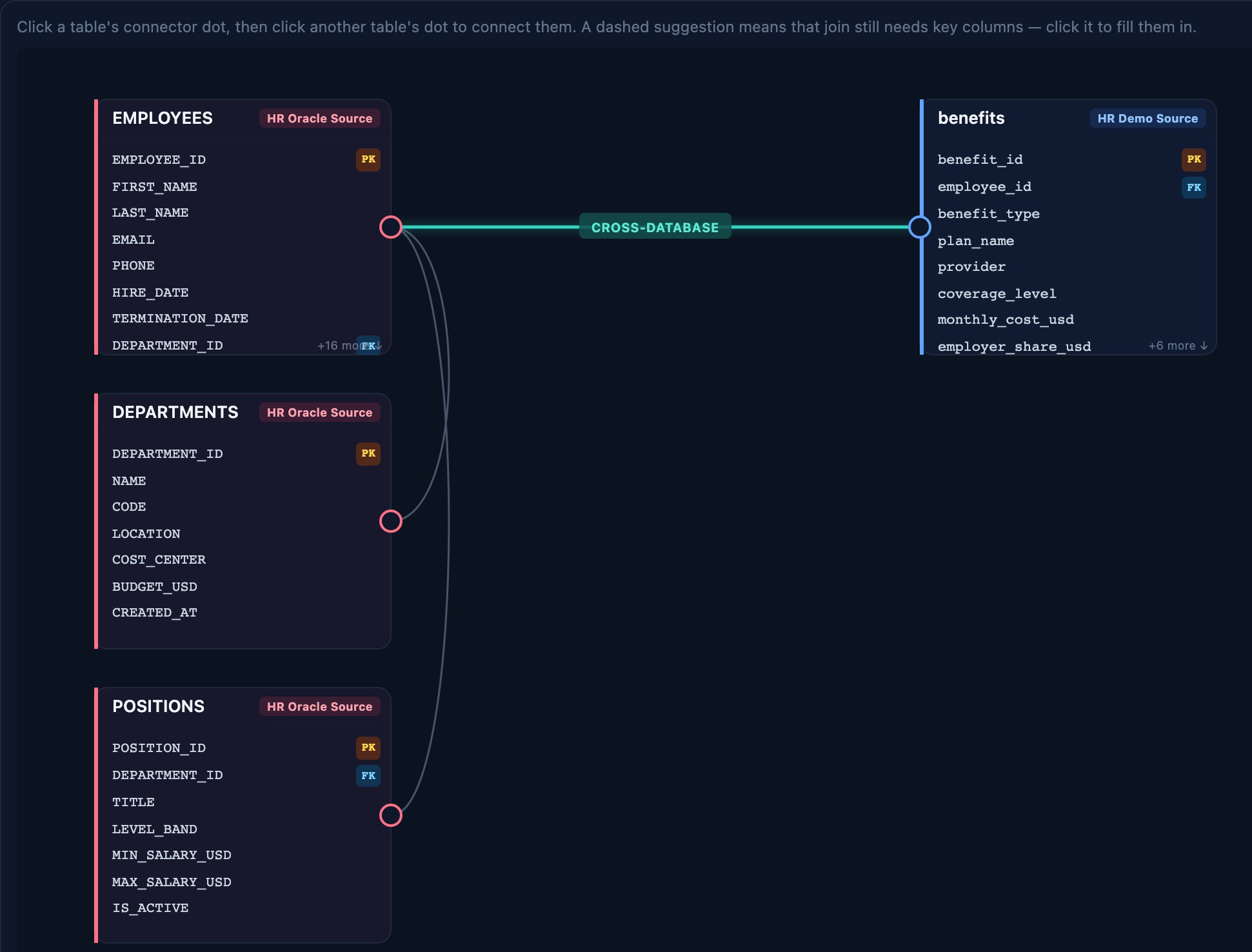
Schema Canvas is no longer just something you review after the fact — it’s where you build the join. The same visual map now lives inside the migration form: click a table’s connector dot, click another’s, and the join between them is wired up. Every relationship it finds is labeled by how sure it is — a declared match comes straight from the database’s own foreign-key metadata (near-certain, because the database itself says so), a suggested match is Stryde’s own name-and-type read across two schemas with a confidence score attached — click either and the join fills in automatically. Anything crossing a database boundary is still flagged as its own category. No separate model to draw or maintain — it reads directly off what’s actually configured, so it’s never out of sync with reality.
See it against your own data.
The best way to evaluate a migration tool is to point it at a real migration. Let's set one up.